KET Speaking Practice 1
Speaking can't be auto-graded the way Reading or Listening can — this is a real practice set for two students (or a student and teacher) to run together, with the examiner's actual questions and timing.
Getting to know you
The examiner asks each candidate some questions about themselves (e.g., daily life, hobbies, school). Candidates answer the examiner (not each other) using short, simple sentences.
Strategy Walkthrough
Goal: Show you can answer basic personal questions confidently.
- Don't give one-word answers. If asked "Where do you live?", say "I live in Madrid, which is a big city in Spain" rather than just "Madrid."
- Don't memorize long speeches. It sounds unnatural and examiners will interrupt you.
- If you don't understand, it's completely fine to say: "Could you repeat that, please?"
- Examiner: What's your name? And what's your surname?
Good answer: "My name is Maria, and my surname is Garcia." - Examiner: Where do you live?
Good answer: "I live in a small flat in the centre of Rome with my family." - Examiner: Do you work or are you a student?
Good answer: "I'm a student. I study at a high school near my house." - Examiner: What do you usually do in the evening?
Good answer: "I usually do my homework, eat dinner with my parents, and then watch some TV." - Examiner: Tell me something about your best friend.
Good answer: "My best friend is called David. He is very funny and we like playing football together on Saturdays."
Collaborative Task: Free Time Activities
Examiner: "Now, in this part of the test you are going to talk together. Here are some pictures that show different free time activities. Do you like these different free time activities? Say why or why not. I'll say that again. Do you like these different free time activities? Say why or why not. All right? Now, talk together."
Strategy Walkthrough
Goal: Show you can have a simple conversation with your partner, ask questions, and give reasons for your opinions.
- Talk to your partner, not the examiner. Look at them and ask what they think: "Do you like playing football?", "What about reading?"
- Give a reason. Instead of just "I don't like reading", say "I don't like reading because I find it a bit boring."
- React to your partner. Use phrases like "Me too!", "Really? I don't like it," or "I agree."
 Picture 1: Playing football in a park
 Picture 2: Reading a book at home
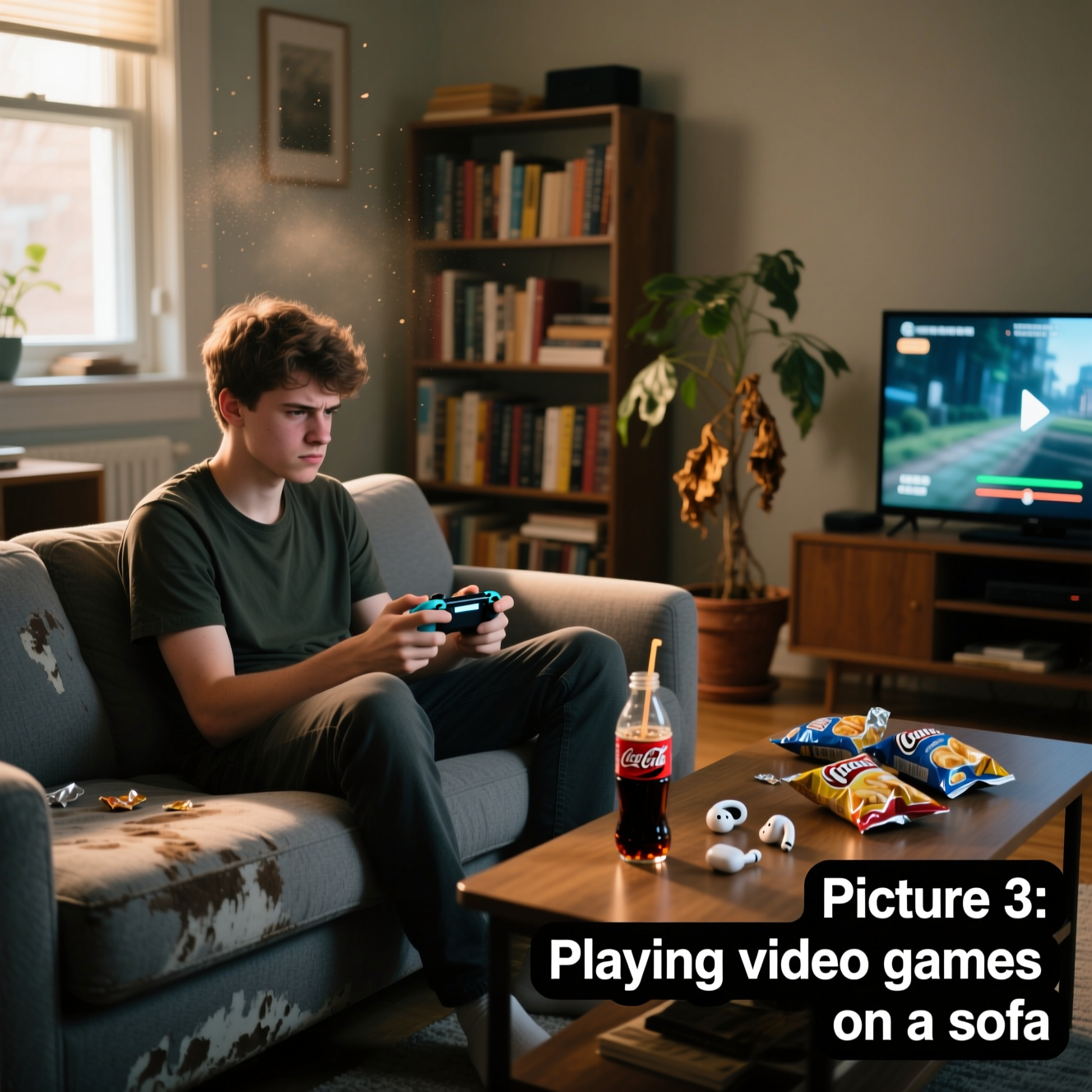 Picture 3: Playing video games on a sofa
 Picture 4: Shopping for clothes
 Picture 5: Riding a bicycle
Example Conversation (Candidates talking together for 1–2 minutes):
Candidate A: "Do you like playing football in the park?"
Candidate B: "Yes, I love it because it's good exercise. And you?"
Candidate A: "I like it too, but I prefer riding a bicycle. It's very relaxing. Do you like reading books?"
Candidate B: "No, I don't. I think it's a bit boring. I prefer playing video games with my friends on the sofa."
Examiner asks one or two questions on the topic:
- Do you think playing football is fun?
Good answer: "Yes, I think it's very fun because you can play with a big group of friends." - Do you think reading a book is boring?
Good answer: "Sometimes, yes. But if the story is really good, I enjoy it." - Which of these free time activities do you like best?
Good answer: "I like playing video games best because I can play online with my classmates."
Examiner asks broader questions to finish (Candidates answer examiner):
- Do you prefer to spend your free time alone or with friends? (Why?)
Good answer: "I prefer spending time with friends because we always laugh a lot and it's more fun." - What is the best thing to do in your town in your free time?
Good answer: "The best thing is going to the cinema in the centre, because they show all the new films."